

 02 December, 2025
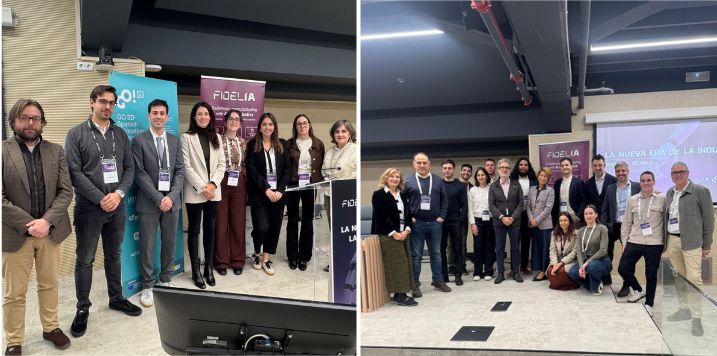
Madrid, December 2, 2025 — The Carlos III University of Madrid (Puerta de Toledo campus) hosted the event “The New Era of Industry,” a technical conference that brought together the smart manufacturing and additive manufacturing ecosystems to reflect on the present and future of the industrial sector. The event served as the official closing of the FIDELIA and GO! projects, both funded by the CDTI’s Innovation Ecosystems program, and highlighted the importance of cross-sector collaboration as a driver to accelerate the transition toward a more digital, sustainable, and competitive industry.
The institutional welcome was delivered by José Moisés Martín Carretero, Director General of CDTI, who emphasized the strategic role that collaborative projects of this kind play in transforming the Spanish industrial fabric and strengthening its international position.
The event opened with a keynote by David Alayón, expert in innovation and disruptive technologies, who spoke about how to face the challenges of an environment defined by acceleration, complexity, and uncertainty. Alayón reflected on the impact of technologies such as artificial intelligence, robotics, and spatial computing, which are driving deep transformations in industrial business models. Faced with this scenario, he proposed moving away from prediction-based thinking and embracing an anticipatory mindset—one grounded in exploring possible futures and actively shaping change from the present.
During the session, the results of the FIDELIA and GO! projects were presented.
FIDELIA aims to develop an intelligent manufacturing ecosystem based on artificial intelligence and deep learning, fostering technologies that enhance efficiency, decision-making, and sustainability in production environments.
Meanwhile, GO! has created an innovation environment focused on accelerating the adoption of additive manufacturing, bringing together key national stakeholders to explore new applications in strategic sectors such as automotive, aerospace, defense, healthcare, and general industry.
The program included a block of technological demonstrators showcasing real industrial applications of artificial intelligence—from dynamic production planning to predictive tool-wear measurement and the use of interfaces for imitation learning in robotics. There were also dedicated sessions on industrial applications of additive manufacturing, with use cases across automotive, aerospace, personalized medicine, and defense.
In parallel, B2B meeting sessions were organized to connect specific technological needs with solutions already available on the market, promoting direct knowledge transfer and creating new collaboration opportunities.
The conference was organized by AFM Cluster, through its specialized associations ADDIMAT and STECH, together with the partners of the FIDELIA and GO! consortia, which include technology centers, universities, and leading industrial companies.
With more than 20 speakers and numerous participants from business, research, and institutional backgrounds, the event reaffirmed the crucial role of collaborative ecosystems as engines of the new industry—where technology, shared knowledge, and innovation stand as fundamental pillars for advancing toward a more competitive and resilient economy.

Subscribe to our newsletter. Just insert your e-mail and you will receive the latest news.